Visual Acoustic Lab
What happens in the moment or some minutes later, when acoustic thinking becomes visual?
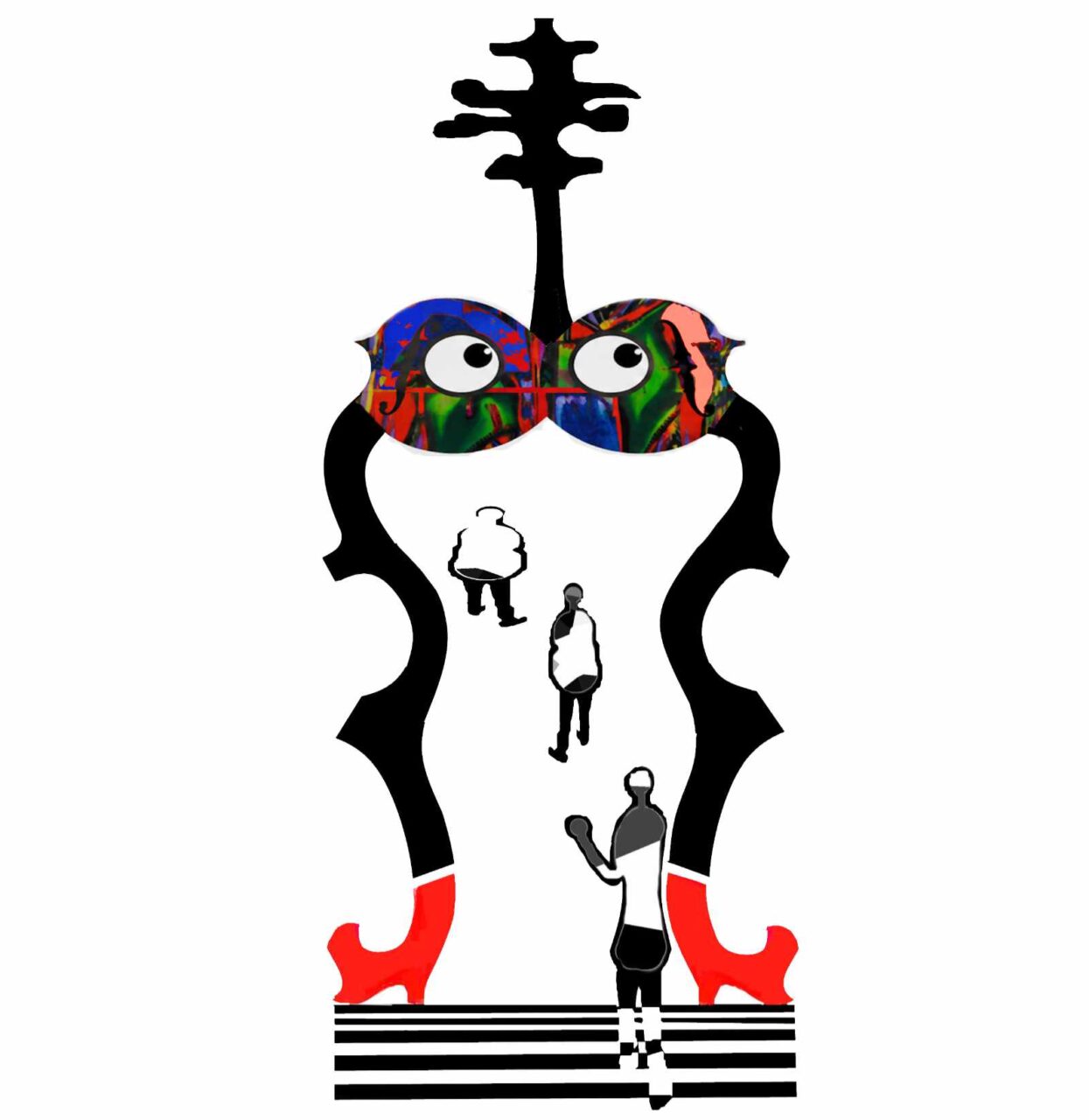
Cello Endrian steht da wie ein Tor, durch das Menschen gehen. Er sieht alles um sich herum. Und lächelt meistens.
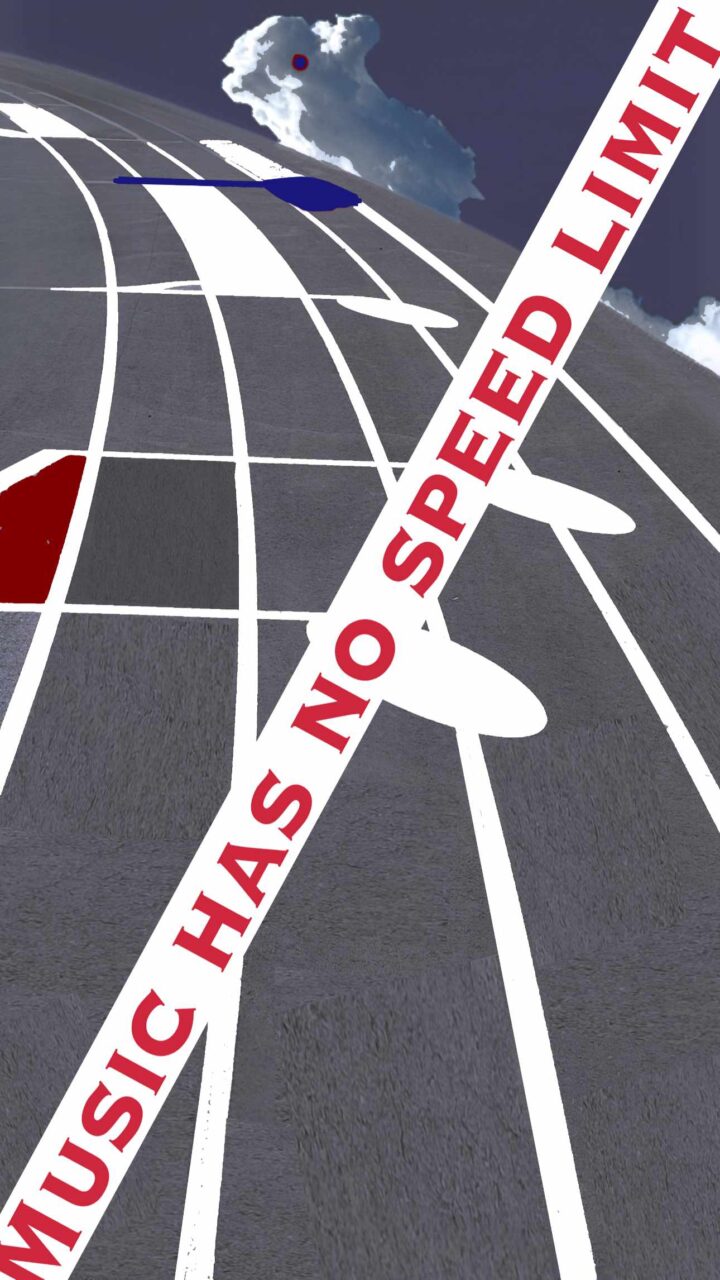
This question lies at the heart of Bojan Basson’s work.
Music has a face. Every instrument has a self.
Basson Visual Acoustics Lab transforms musical instruments into protagonists.
Removed from their familiar surroundings and stripped of their original function, they are given a new identity. In Basson’s images, the violin, cello, piano, trumpet, and other instruments are no longer merely objects. They appear to feel, communicate, remember, yearn, encounter one another—or set out on a journey of their own.
This concept gave rise to the Visual Acoustics Lab, an ongoing artistic exploration at the intersection of music, photography, digital photomontage, design, and surrealist imagery.
Instruments become personalities
I am interested in the musical instrument beyond its function.
What happens to a cello when nobody plays it anymore? What does a trumpet feel when the concert hall remains empty? Where might an instrument fly if it suddenly discovered its own freedom?
My visual worlds emerge from questions like these.
In “Solitude & Longing”, instruments appear along abandoned railway tracks, beside rivers, or in desolate landscapes. Silence becomes the counterpoint to sound.
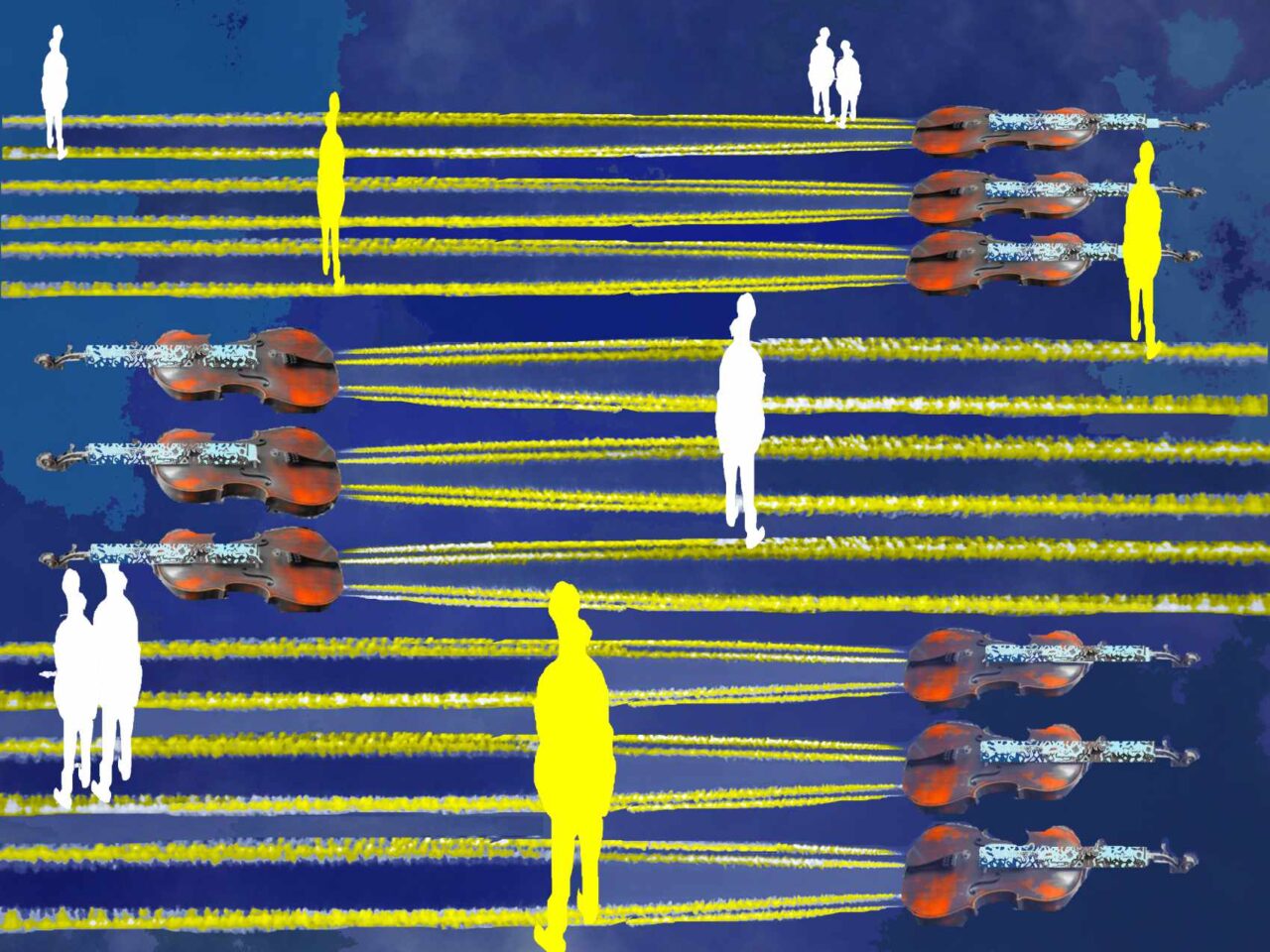
In “Giants of the Air”, musical instruments transform into visionary flying machines. They become symbols of departure, freedom, mobility, and modernity.
Other works tell stories of encounters and romances between instruments. Still others combine musical instruments with architecture, surreal spaces, or unusual natural phenomena.
A cello can become a doorway.
A cloud can suddenly take on a face.
An instrument can fly.
And suddenly, it may even resemble a passenger aircraft.
My formative Influences
My connection to music and art began long before I started making art myself. I grew up in an environment in which music, art, architecture, and the European avantgarde were an immediate part of everyday life.
My mother was a concert pianist who performed at international festivals. As a child and adolescent, I experienced numerous European and Anglo-American cultural events from close range.
Another formative connection to the European musical avantgarde came through the composer and conductor later Giuseppe Sinopoli, who lived with my mother for several years and dedicated several piano compositions to her.
Perhaps these experiences explain my particular sensitivity to space, rhythm, movement, and the relationship between music and visual perception.
From international management to Art
My professional journey took me to cities including Munich, Zurich, London, Barcelona, and Vienna, as well as the Rhine-Neckar region.
Between 2015 and 2020, I developed literary salon formats in Heidelberg, bringing together publishers, actors, authors, and political figures. These activities later extended beyond the Heidelberg region to cities including Frankfurt and Ludwigsburg and ultimately to Berlin and the German Bundestag.
Alongside this professional work, I continued developing a visual language centered on classical musical instruments.
The lockdown of 2020 ultimately marked a turning point.
Digital photomontage opened up new possibilities for translating ideas that had previously existed largely through intuition into systematically constructed images.
It was during this period that the Visual Acoustics Lab emerged.
Between Surrealism and a Wink
My works are serious in intention—yet they do not always take themselves seriously.
I am fascinated by the moment when a familiar object suddenly steps outside its usual role. That is where imagination begins for me.
Some viewers have associated my work with artists such as René Magritte or Salvador Dalí. This comparison initially surprised me, because my visual language developed independently through years of experimentation, intuition, and creative flow.
Yet both artists demonstrated how powerful an image can become when it quietly shifts our expectations of reality.
Humor, design, and surrealist intrigue therefore belong to my visual universe just as much as melancholy, longing, memory, and freedom.
Art that invites a second look
I do not want to create images that merely decorate a room.
I want them to provoke a second look.
Perhaps, at first, the viewer recognizes a musical instrument.
Then a landscape.
Then a situation.
Then a story.
And eventually, perhaps, the question arises:
Why is this instrument standing there—and what might it be telling us?
My musical instruments have been stripped of their original purpose.
That is precisely where their emancipation begins.
They no longer need to produce sound.
Now they are free to tell their own stories.